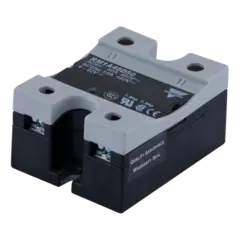
Carlo Gavazzi Solid State Relays
Carlo Gavazzi RM1A solid state relays stocked in India — single-pole panel-mount SSRs with zero-cross switching and DC control, in 25 A, 50 A, 75 A and 100 A ratings across the 230 V and 400 V classes. GST invoice, pan-India delivery.
What the RM1A is for
The RM1A switches an AC load with semiconductors instead of contacts. Nothing arcs, nothing pits, and nothing wears out from cycling — which is the whole point. On a heater that switches every few seconds, a mechanical contactor is a consumable; an SSR is not.
These are zero-cross switching units, meaning the relay waits for the AC waveform to cross zero before turning on. That keeps the electrical noise down, which matters when the same panel carries a PLC and a set of sensors. All the units we hold take a DC control signal in the 3–32 V range, so a standard PLC output drives them directly, and they include built-in overvoltage protection.
The range in stock
| Part number | Rated current | Output class |
|---|---|---|
| RM1A23D25 | 25 A | 230 V class, 24–265 VAC |
| RM1A23D50 | 50 A | 230 V class |
| RM1A23D75 | 75 A | 230 V class |
| RM1A23D100 | 100 A | 230 V class |
| RM1A40D25 | 25 A | 400 V class |
| RM1A40D50 | 50 A | 400 V class |
| RM1A40D75 | 75 A | 400 V class |
| RM1A40D100 | 100 A | 400 V class |
The code is readable once you know the pattern: RM1A is the single-pole panel-mount family, the next two digits are the output voltage class — 23 for 230 V and 40 for 400 V — D marks the DC control input, and the trailing number is the rated current in amps. So RM1A40D75 is a 400 V class, DC-controlled, 75 A relay.
Where they are used
Heater control
Extruders, ovens, sealing jaws and hot plates, where the element cycles constantly and a contactor would not last.
Temperature loops
Driven from a controller output, giving fast, silent switching with no contact bounce.
Packaging machines
Sealing bars and shrink tunnels, where cycle rates are high and downtime is expensive.
Noise-sensitive panels
Zero-cross switching keeps interference away from the sensors and PLC sharing the enclosure.
Specifying one
- Size on the real load current, then derate. Running an SSR near its rating is the usual cause of failure.
- Fit a heatsink and give the panel airflow — these dissipate real heat at higher currents.
- Match the voltage class — 230 V or 400 V, decided by your supply, not by the load rating.
- Check the control output from your PLC or controller sits inside the DC input range.
- Consider the load type. Resistive heaters are straightforward; inductive loads need more margin.
- Use a semiconductor fuse. An ordinary fuse will not clear fast enough to protect the device.
Buying Carlo Gavazzi relays in India
Industrypapa supplies Carlo Gavazzi solid state relays to machine builders, packaging and plastics plants and maintenance teams across India. If you are replacing a failed unit, send us the code from the label; if you are specifying a new panel, tell us the load current, supply voltage and control signal and we will size it. GST invoice, pan-India delivery.
Related ranges: temperature controllers, power supplies, limit switches and inductive proximity sensors. For anything not listed, send us the part number.
Frequently asked questions
What does RM1A mean?
It is Carlo Gavazzi's single-pole panel-mount solid state relay family. The digits that follow give the voltage class and the current rating.
How do I choose between 23 and 40?
By your supply voltage, not the load. The 23 codes are for the 230 V class and the 40 codes for 400 V.
Do these need a heatsink?
At these current ratings, yes. Heat is what kills solid state relays, so mount them on an adequate heatsink with room for air to move around them.
Can I drive one straight from a PLC?
Usually yes — the control input accepts a DC signal in the 3–32 V range, which covers a standard 24 V PLC output. Confirm the output can supply the input current.