Label Sensor
Label gap sensors for labelling and print-and-apply machines — optical forks for paper labels, ultrasonic heads for clear-on-clear film — from Datalogic, Tri-Tronics, Micro Detectors and VoxinTech. All stocked in India with a GST invoice. Tell us the label material and web width and we will confirm which of these will actually hold on your machine.
Why clear labels need a different sensor
A label sensor's job sounds simple — find the gap between labels on the backing web so the machine knows when to dispense. In practice the label and its liner differ by a fraction of a millimetre, and that is what makes the choice of sensing technology the whole decision.
Paper labels on paper liner give enough optical contrast for a standard infrared or red-LED fork sensor. Clear labels on clear liner give almost none: the light passes through both, and an optical sensor sees much the same signal whether a label is present or not. That case needs either an ultrasonic fork, which reads the difference in sound transmission through one layer versus two, or a purpose-built clear-label optical head. If you are running transparent or metallised film, this is the specification that matters — everything else is secondary.
Label sensors stocked at Industrypapa
| Part number | Brand | Technology | Suits |
|---|---|---|---|
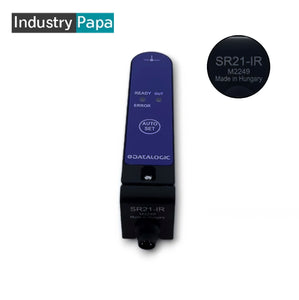
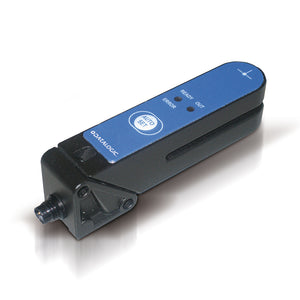
| SR21-IR | Datalogic | Optical fork, infrared | Paper labels, 2 mm resolution |
| SR21-RG | Datalogic | Optical fork, red/green LED | Paper and coloured labels |
| SR23-5-IR-PH | Datalogic | Optical fork, infrared, external teach | Paper labels, remote teach |
| LER | Tri-Tronics | LABEL-EYE, red LED | Paper labels, NPN/PNP |
| LERC | Tri-Tronics | LABEL-EYE, red LED, moulded cable | Paper labels, 24 V DC |
| LERC-10 | Tri-Tronics | LABEL-EYE gap sensor | Labels on a web |
| MLENC | Tri-Tronics | Mini Label Eye, infrared | Tight fixtures, NPN |
| MLEP | Tri-Tronics | Mini Label Eye, infrared | Tight fixtures, PNP |
| CLSC-1 | Tri-Tronics | Clear Label Sensor | Clear labels |
| FC8U/0B-M307-1F | Micro Detectors | Ultrasonic fork | Clear labels, 3 mm slot, 69 mm depth |
| ULS24B360M84 | VoxinTech | Ultrasonic fork | Clear and transparent labels |
| ELS24B342M84 | VoxinTech | Optical, infrared 940 nm | Paper labels on backing |
| ELS24B342M84-M | VoxinTech | Optical, infrared 940 nm, M8 plug | Paper labels, 4-pin M8 |
Optical forks
The default choice for paper labels. Emitter and receiver sit on the two arms of one housing, so alignment is fixed at manufacture and cannot drift with machine vibration — the usual cause of intermittent faults with separate through-beam pairs. The Datalogic SR21 resolves down to 2 mm.
Ultrasonic forks
For clear-on-clear. The head reads how much sound passes through the web, which changes when a label doubles the material in the slot, so transparency is irrelevant. Slot width limits what will physically fit — the FC8U takes 3 mm.
Clear-label optical
The Tri-Tronics CLSC-1 is an optical head tuned specifically for clear labels — an alternative to ultrasonic where the web is too thick or too wide for a fork slot.
Miniature heads
The Tri-Tronics Mini Label Eye range fits where a full-size fork will not. MLENC is NPN output, MLEP is PNP — match it to the PLC input the machine already uses.
Choosing a label sensor
- Label material first. Paper on paper goes to an optical fork. Clear on clear, or metallised film, needs ultrasonic or a clear-label head.
- Check the slot. The web must pass through with clearance. A narrower slot gives finer resolution but less room.
- Match the output. PNP or NPN to suit the existing PLC input; changing this later means changing the sensor.
- Cable or connector. A moulded cable costs less; an M8 plug makes replacement a two-minute job during a production stop.
- Send us a sample if you are unsure. Clear-label applications are the ones that work on paper and fail on the machine, or the reverse.
Common questions
Which sensor detects transparent labels?
An ultrasonic fork such as the Micro Detectors FC8U/0B-M307-1F or the VoxinTech ULS24B360M84, or the Tri-Tronics CLSC-1 clear-label optical head. A standard optical fork will not hold on clear-on-clear.
What is a label gap sensor?
The same thing. It detects the gap between labels on the backing web, which is the signal a labelling machine uses to time each dispense.
Can I use an ordinary photoelectric sensor instead?
Rarely with good results. The difference between label and liner is a fraction of a millimetre, and a general-purpose sensor lacks the resolution and the fixed fork alignment that keep detection repeatable at production speed.
Do I need a separate amplifier or cable?
These are self-contained sensors — no amplifier is needed. M8 cordsets are stocked alongside; see cables and connectors.